Every year, over 2.2 billion tonnes of solid waste are generated worldwide, with up to 40% remaining untreated. This leads to severe contamination of soil, air, and water. Traditional methods like incineration and landfilling release massive amounts of greenhouse gases — about 173 million tonnes of CO₂-equivalent emissions in 2023 while offering poor energy recovery.
At the same time, heavy industries such as cement, steel, and chemicals produce more than 30% of global CO₂ emissions, and current hydrogen production adds another 830 million tonnes annually. The result is a mounting environmental crisis demanding cleaner, more efficient solutions.
EXPLAINING PLASMA
THE FOURTH STATE OF THE MATTER.
Plasma is generally known as the fourth state of matter. It contains a significant portion of charged particles – ions and/or electrons by further energizing gases through heating. At these extreme conditions molecular dissociation breaks apart any complex organic molecules into their individual atoms. Inorganic matter is melted and will end in chemically inert and safe to handle slag that can be used as a construction material.
PLASMASUN SOLUTION
CONQUERING THE WORLD'S MOST URGENT ENVIRONMENTAL ISSUES.
METHANE PLASMALYSIS
Methane cracking for clean hydrogen production.
WASTE PYROLYSIS
Transforming various waste into valuable syngas and carbon black with CO2 reduction.
PLASMA KILN
Re-equipment of industrial gas torches with plasma torches.
METHANE SPLITTING WITH PLASMASUN
DIRECT CURRENT PLASMA FOR PURE
HYDROGEN EXTRACTION
PlasmaSun uses a DC plasma system, which achieves higher energy efficiency compared to AC systems. The DC plasma system also provides higher plasma densities and better control of plasma temperatures than AC and high frequency systems.
The starting material is pyrolyzed at temperatures of over 3,000 K using the plasma torch. Pyrolysis, i.e. the thermal decomposition of the chemical components without oxidation, breaks down the complex organic molecules into their individual atoms through molecular dissociation. The only residues are hydrogen and solid carbon, which can be used as a valuable raw material in industry.
TECHNOLOGY COMPARISON
Feature
SMR
Electrolysis
PlasmaSun
Energy efficiency
~
-
+
Without CO2 emissions
-
+
+
No natural resource consumption
-
-
+
Potential Operating Costs
+
-
~
Waste Treatment
-
-
+
Feature
SMR
Elektrolysis
Plasma
Energy efficiency
~
-
+
Without CO2 emissions
-
+
+
No natural resource consumption
-
-
+
Potential Operating Costs
+
-
~
Waste Treatment
-
-
+
WASTE PYROLYSIS WITH PLASMA
TRANSFORMING VARIOUS WASTE INTO VALUABLE SYNGAS AND CARBON BLACK WITH CO2 REDUCTION.
Tonnes of waste are dumped every day, releasing harmful greenhouse gases such as methane (CH₄) and CO₂. The currently prevailing measures and national commitments are not sufficient to achieve the 1.5°C target. Our goal is to break down mixed waste and produce Syngas (H₂ + CO) minimizing production of CO₂. Further Carbon Black is produced, binding carbon from being released into the atmosphere.
Potential applications:
On-site waste treatment
Carbon black capturing
Waste to energy
Hydrogen/syngas production
Before
Contaminated wood waste
Plastic waste
Waste containing oil and toxic substances
Contaminated soil
plasma TORCH
High stability, consistency and durability
Organic toxins are destroyed
Gases are split, separated and purified
No dust is released
The volume is significantly reduced and the material is inertized
OUTPUT
Organic materials converted into synthesis gas (Hydrogen + CO)
Resulting ash can be further processed, vitrified, and made inert
Produced carbon can be reused in various products (e.g. car tires, activated carbon filters)
PLASMASMA KILN
RE-EQUIPMENT OF INDUSTRIAL GAS TORCHES WITH PLASMA TORCHES.
The CO2 emissions need to drop significantly in the following years. CO2 intensive industries are challenged to implement new technologies transforming the current processes relying heavily on the burning of fossil fuels.
One example is the kiln process, where high temperatures are usually achieved by burning natural gas. Thus, the CO2 from this burning process is released alongside any additional CO2 formed in the kiln process.
TO DECREASE THE CO2 EMISSIONS, AN ALTERNATIVE HEATING PROCESS MUST BE IMPLEMENTED TO REPLACE THE BURNING OF NATURAL GAS.
Nonstationary Kiln (Batch Kiln)
Nonstationary kilns have an increased flexibility concerning sinter temperature and firing curve compared to a stationary kiln. Further, they can be easily shut down. However, nonstationary kilns exhibit a lower energy efficiency, increasing operational costs.
Stationary Kiln
(Tunnel Kiln) Stationary kilns require a constant sinter temperature and cannot be easily shut down for a short time span. In general, these kilns exhibit a higher energy efficiency and thus lower costs during operation.
PLASMA KILN KEY FEATURES
Emissions Reduction
Eliminated CO₂ emissions from combustion, empower industries to meet decarbonization targets and regulatory compliance.
Fuel Flexibility
Shift to renewables (solar, wind, hydro, etc.) without changing the burner hardware—ensuring long-term sustainability and cost stability.
High Temperatures
The process gas can reach higher temperatures allowing for increased performance, like ramp speed, at higher temperatures.
Simplified Infrastructure
Eliminates the need for storing, handling, and piping combustible gases.
DRIVING TRUE CHANGE
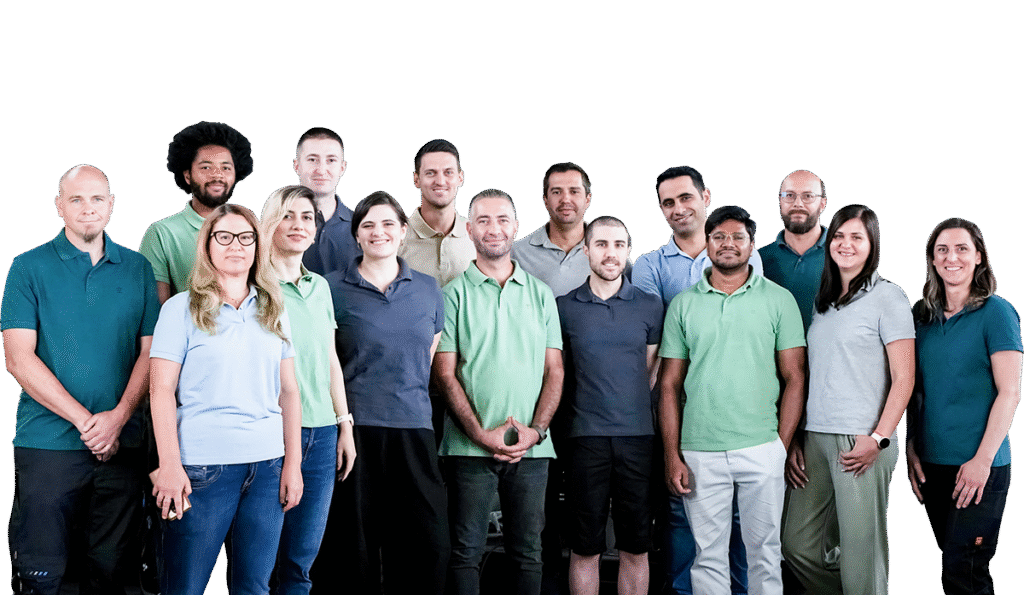
PEOPLE BEHIND THE TECHNOLOGY.
With PlasmaSun we turn environmental challenges into sustainable & economical opportunities.