Bauxite residue is a major environmental challenge due to its high alkalinity. The storage and disposal can cause problems such as contamination of groundwater due to alkali seepage, impacting air quality with alkaline dust which has its effect on plant life, and a large area of land required for its disposal. Currently, the most common method of disposing of red mud is landfilling.
This method involves depositing the waste in a designated area and covering it with soil or other materials to prevent the release of harmful substances into the environment. However, this method is not without its challenges. Landfilling is costly, unsafe, requires a large amount of land, and the waste must be carefully managed to prevent contamination of the surrounding environment.
REDREC TECHNOLOGY
NEUTRALIZES BAUXITE RESIDUE AND EXTRACTS SECONDARY RAW MATERIALS WHILE BOOSTING CIRCULAR ECONOMY.
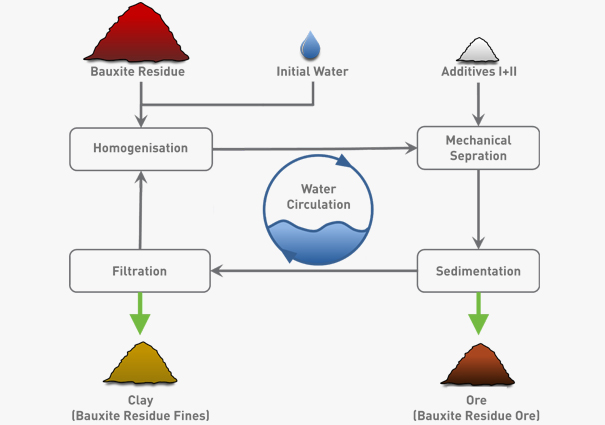
This process does not generate any additional waste and recycles water within the system. It’s important to note that the original composition of the bauxite residue undergoes no chemical changes during this process, but is instead mechanically separated.
In the first step, the starting material is homogenized and then separated purely mechanically. The process water is bound in a circulation system so that no water is wasted during sedimentation and filtration. Refining purest raw materials for industrial use.
AFTER
RedRec result I: fine ore
RedRec result II: pure clay
Recovery of light and heavy metals
Utilisation of the mineral fraction
BAUXITE RESIDUE REIMAGINED
From waste to worth — our mission is to turn toxic landfills into valuable assets. What began as a challenging and ambitious journey has evolved into one of the most impactful and sustainable solutions to a global environmental challenge. Simple, clean, effective.
Wolfgang Kapaun, Project Lead.
REDREC TECHNICAL HIGHLIGHTS
FROM POLLUTANT TO RAW MATERIAL.
The Red Rec process first disperses the bauxite residue particles and builds up hydration shells around the particles to then use fractioned sedimentation to remove iron heavy fractions. The suspension is filtered to receive refining clay and the process water is returned to the start of the process.